


4 min read
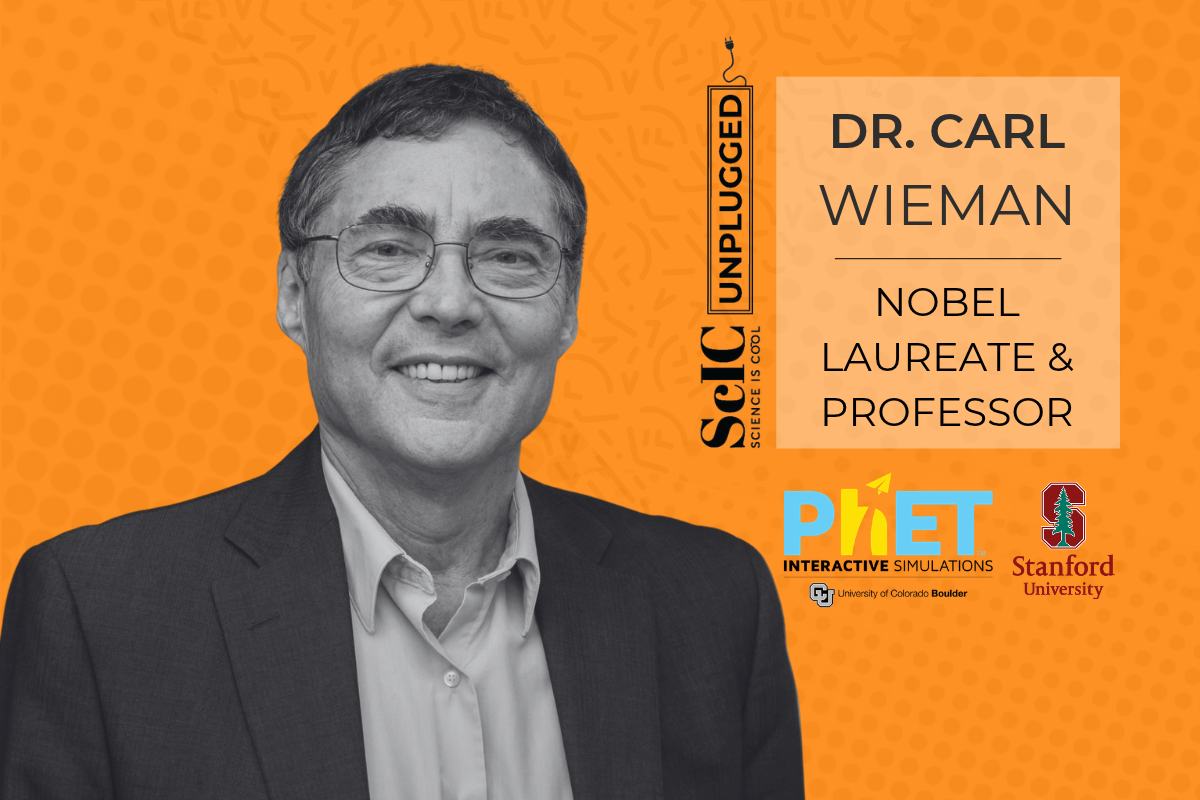

Why do PhET simulations work so well for so many students? On this episode of Science Is Cool Unplugged, Nobel Prize–winning physicist Carl Wieman, founder of PhET Interactive Simulations, explains the research behind the free science simulations that teachers and students use in classrooms around the world. He shares how PhET began, why interactive simulations help students reach the "aha" moment, and how teachers can use PhET simulations to build real scientific thinking. Dr. Wieman also connects PhET's design to broader research on how people learn, including deliberate practice, minds-on learning, and the risks AI poses when it gives students answers instead of making them think.
How PhET Interactive Simulations Began
Long before his Nobel Prize, Dr. Wieman ran two research groups side by side: one using lasers to study atoms, and one studying how students learn physics. PhET grew out of that overlap. A software engineer was building simulations to help explain Dr. Wieman's research, and once he saw them in use, the benefit was clear. Interactive simulations worked for a much wider range of learners and backgrounds than any other educational media he had seen. He launched PhET at the University of Colorado Boulder in 2002.
Today, PhET simulations are a fixture in science classrooms from elementary school through college. Dr. Wieman says his college students are often more impressed that he started PhET than that he won the Nobel Prize, because they all used PhET in high school. Dave's own middle schooler recently came home with a PhET simulation on her Chromebook.
Why PhET Simulations Spark the "Aha" Moment
Scientists visualize what is happening inside a system, and PhET simulations make that thinking visible. When a student changes the voltage in a circuit simulation and immediately sees the electrons respond, the relationship clicks. As Dr. Wieman puts it, that is the aha moment: realizing these things are related in a certain way. Visual, interactive simulations let students see what they would otherwise have to imagine from a textbook, and even cartoonish visuals help students picture what will happen.
That effect is designed on purpose. Every PhET simulation is tested with students. If students miss something important, the team makes it more obvious, such as enlarging the electrons until students notice how they behave. The controls are built so students can't miss the variables that matter and want to experiment with them. Dr. Wieman notes that his research data shows well-designed simulations can outperform physical apparatus for learning concepts, because a real apparatus has complications that can hide the relationships students need to see.
PhET Simulations Don't Give Students the Answer
One of the most important points Dr. Wieman makes is what a simulation does not do. A PhET simulation never hands students the answer. Students change variables, observe what happens, and put the behavior together in their own minds to build a model of how the system works. That is a key difference from answer-giving AI tools, and it is why simulations support learning rather than replace it.
Many PhET simulations also let students take measurements and collect data directly in the simulation. The PhET team has even experimented with adding small amounts of noise to some simulations, so students learn to reason with imperfect data the way scientists do.
How to Use PhET Simulations in Your Classroom
Dr. Wieman's research points to practical ways teachers can get more learning out of every PhET simulation:
Keep students' minds on. The value of any activity, hands-on or virtual, comes from students actively thinking. Ask students to predict what will happen before they change a variable, then explain what they observed.
Let students make decisions. His research found that typical science problems remove most of the decisions real scientists make, such as what information is needed and how to get it. Give students room to decide what to test, what to measure, and what their results mean.
Focus on relationships between variables. Have students change one variable at a time and describe the cause-and-effect relationship they see. That is where the conceptual model forms.
Use the data tools. Ask students to collect measurements inside the simulation, graph them, and compare their findings with what they expected. Teachers who also collect real-world data with sensors can have students compare simulated and measured results and discuss why they differ.
Resist giving the answer. The power of a simulation is that students build the model themselves. Guide with questions, not explanations.
Learning Develops Brains, Not Fills Them
According to Dr. Wieman, the biggest shift education needs is moving away from the idea that learning means filling fixed brains with knowledge. Research supports a different view: learning develops the brain's capabilities, and students get better at the kinds of thinking they actually practice. PhET simulations are built around that idea, giving students repeated practice reasoning about how systems behave.
Deliberate Practice and Scientific Thinking
Drawing on psychologist Anders Ericsson's research on expertise, Dr. Wieman explains the difference between routine practice and deliberate practice. Deliberate practice means breaking a complex skill into parts, focusing intently on each one, and steadily taking on harder challenges. "You don't learn music by being told to go play a Mozart symphony," he says. Scientific thinking works the same way, and simulations give students a low-stakes place to practice each piece of it.
AI, Cognitive Offloading, and the Limits of AI Tutors
Dr. Wieman sees cognitive offloading as the biggest danger AI poses to education. AI tools are built to give answers, and answers feel like learning without the mental effort learning requires. "People don't learn from it. They think they learn from it," he says. His team is building an AI tutor designed to nudge students rather than tell them, but he notes a deeper limit: a skilled human tutor carries a model of how a student is thinking, and AI does not. In a sense, he says, PhET simulations are a form of artificial intelligence themselves, responding to what students do, and in some ways they are more educationally productive than large language models.
Listen to the Episode
Listen to PhET founder Carl Wieman on Science Is Cool Unplugged for a research-based look at PhET simulations, interactive learning, deliberate practice, and helping students build real scientific thinking in the age of AI.
PhET Lessons in PocketLab Notebook: https://app.thepocketlab.com/pocketlab-library?filters=PhET
PhET Interactive Simulations: https://phet.colorado.edu/
ABOUT CARL
Carl Wieman is a physicist and science education researcher who shared the 2001 Nobel Prize in Physics for creating the first Bose-Einstein condensate. He founded PhET Interactive Simulations at the University of Colorado Boulder in 2002, which provides free, research-based science and math simulations used by teachers and students worldwide. His research focuses on how people learn science and engineering, including expertise, problem-solving, and effective teaching practices. He continues to serve as a senior advisor to PhET.
